Etsy vs Shopify – Which Platform Should You Choose?
Etsy vs Shopify — which one is the smarter choice for building your online presence? If you’re stepping into ecommerce for the first time, the decision can feel overwhelming. Should you join an established marketplace like Etsy, where millions of shoppers are already searching for products, or should you create your own Shopify store, gaining full control over branding and operations? The answer depends on more than just convenience — it’s about the long-term strategy you choose for your business.
Think of Etsy as a bustling mall where your store is one among thousands. You get instant foot traffic, but you also compete with countless sellers and pay marketplace transaction fees. Shopify, on the other hand, is like owning your own building in a prime location. It offers freedom, but it’s up to you to drive customers through the door. This difference impacts everything — from how much control you have over your customer list to how easily you can adjust your branding and pricing.
So which path leads to greater success: joining the crowd or standing out with your own brand? In this detailed guide, we’ll break down the pros and cons of Etsy, the strengths and challenges of Shopify, and how to decide which model fits your business goals.


Understanding the Core Differences Between Etsy and Shopify
Before diving into features, it’s important to understand that Etsy and Shopify represent two fundamentally different approaches to ecommerce. Etsy is a marketplace — a centralized platform where multiple sellers list their products. Shopify is a website builder and ecommerce platform that lets you create a standalone store.
1. Etsy – The Marketplace Model
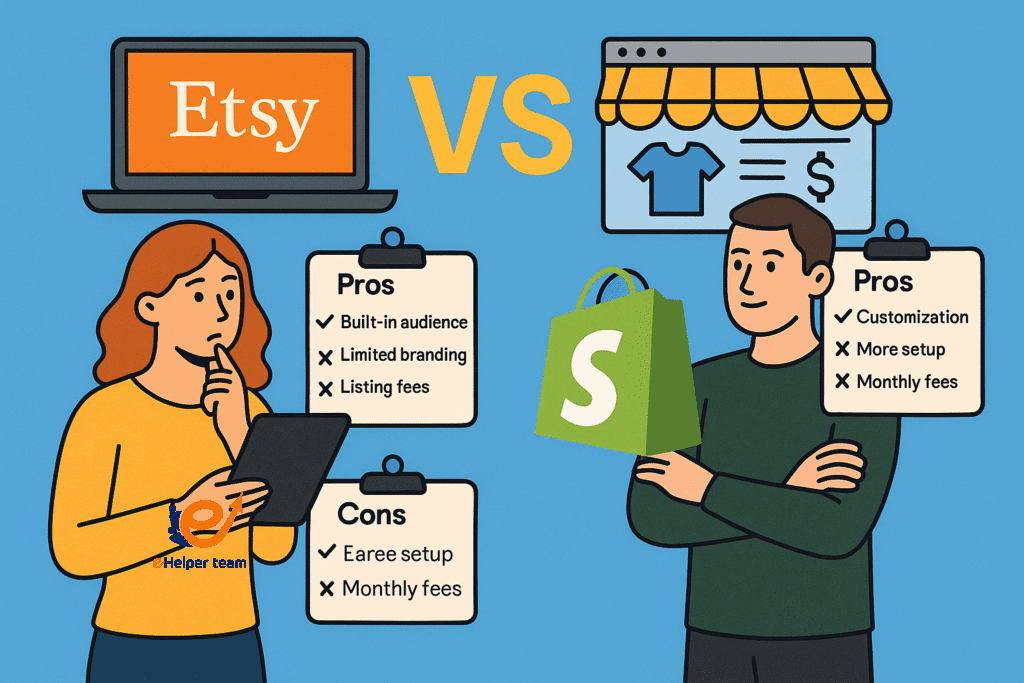
Instant access to a built-in audience.
Lower upfront setup effort.
Limited control over branding and customer data.
Fees for listings, transactions, and payment processing.
2. Shopify – The Standalone Store Model
Full branding control and customization.
Ownership of customer list and data.
Higher responsibility for driving traffic.
Subscription-based pricing.
Pros and Cons of Etsy
Etsy’s biggest advantage is its audience reach. It’s an ideal choice for small businesses, artists, and crafters who want to start selling quickly without worrying about web development.
Pros:
Large built-in customer base.
Easy listing process.
Trust and credibility from being part of a recognized platform.
Cons:
High competition from other sellers.
Limited design and branding options.
Transaction fees and listing costs add up.
Pros and Cons of Shopify
Shopify offers the opposite trade-off — more work upfront for greater control long-term.
Pros:
Total control over store design and branding.
Ability to integrate with multiple payment gateways.
Ownership of customer list for email marketing and retargeting.
Cons:
Monthly subscription fees.
Marketing and traffic generation are your responsibility.
Learning curve for customization and integrations.
Branding Control – The Deciding Factor for Many Sellers
If owning your customer list and having total creative freedom are priorities, Shopify takes the lead. On Etsy, customers are loyal to the marketplace brand, not individual sellers. Shopify allows you to create a unique shopping experience tailored to your audience.
For example, your homepage, product pages, and checkout process can reflect your brand identity entirely, whereas Etsy enforces uniformity across all sellers. This affects not just aesthetics, but also customer retention.
Transaction Fees and Long-Term Profitability
Fees are a critical point in the etsy vs shopify decision. Etsy charges listing fees and takes a percentage of each sale. While Shopify also charges transaction fees unless you use Shopify Payments, these can be lower per sale in high-volume situations.
A detailed comparison of platform economics, such as the one in Shopify vs WooCommerce, can give valuable insight into how fees stack up over time.
Marketing Power and Customer Acquisition
Etsy provides exposure through its own search system and advertising tools, making it easier for beginners to get their first sales. However, this comes at the cost of control. Shopify demands more effort in marketing but rewards you with the freedom to use SEO, content marketing, social media, and paid ads without platform restrictions.
Connecting your store to tools like Google Analytics and advanced marketing software allows you to measure results and refine strategies — an option far more open on Shopify than on Etsy.
Business Models – Which One Fits Your Goals?
Choosing between Etsy and Shopify also depends on your business model. If your focus is quick sales with minimal setup, Etsy is appealing. If your plan is to build a brand and expand product lines, Shopify offers better scalability.
Understanding the Business-to-Consumer model and how it plays out in each platform is crucial. You can explore a detailed explanation in this B2C article.
Case Study – From Etsy to Shopify
Consider a handmade jewelry business that started on Etsy. The seller quickly built a following but realized they couldn’t email customers directly or customize the shopping experience. After switching to Shopify, they gained control over customer retention campaigns, reduced fees, and tripled their repeat customer rate within a year.
This real-world shift highlights how the platform you choose can shape the future of your business.
Writing a Comparison That Converts
If you’re planning to present your own Etsy vs Shopify review to an audience, structuring it effectively is key. Tips from this guide on writing comparison posts show how to balance facts with persuasive elements that guide readers toward action.
External Expert Insight
According to this authoritative source, marketplaces and standalone stores have fundamentally different cost structures, competitive pressures, and brand ownership levels. Recognizing these differences early can prevent costly mistakes and help align your sales channel with your long-term vision.
Beyond the common comparisons often made between etsy vs shopify, there are several additional factors that can significantly influence your final decision. These points focus on support, global reach, checkout experience, third-party tools, multi-channel selling, and scalability:
Customer Support and Seller Assistance: Shopify offers 24/7 support via live chat, email, and phone, while Etsy relies more on forums and email correspondence.
Global Reach and International Selling: Shopify allows multiple storefronts with local currencies and payment methods, whereas Etsy’s reach can be limited by location-based factors.
Checkout Experience and Payment Options: Shopify enables a customizable checkout with upsells and promotions, while Etsy provides a standardized checkout for all sellers.
Third-Party App Ecosystem: Shopify’s extensive app store supports advanced analytics, automation, and inventory management, while Etsy has more basic integrations.
Multi-Channel Selling Opportunities: Shopify connects directly to Facebook, Instagram, TikTok, Amazon, and eBay, while Etsy primarily keeps sales within its own marketplace.
Scalability for Growth: Shopify offers tiered plans up to Shopify Plus for large enterprises, while Etsy is more suited to small and medium-sized sellers.
FAQs – Etsy vs Shopify
Q1: Which is better for beginners — Etsy or Shopify?
Etsy is easier for beginners due to its built-in audience, but Shopify offers more control for brand building.
Q2: Can I sell on both platforms?
Yes, many sellers start on Etsy for exposure and later add a Shopify store for long-term brand growth.
Q3: Which has lower fees?
Etsy charges per listing and takes a percentage of each sale. Shopify has monthly fees and possible transaction fees, which may be cheaper for high-volume sellers.
Q4: Which platform is better for SEO?
Shopify gives you more control over SEO optimization, while Etsy’s SEO is limited to marketplace search.
Q5: Who owns the customer data?
On Shopify, you do. On Etsy, the platform does.